Showing posts with label cycling culture. Show all posts

Tuesday, May 1, 2012

Caravane, la grande pédalée

    
An infallible sign that cycling is becoming mainstream in a community is when you see minority demographics (i.e. racial, age, gender or other), getting involved, being empowered and taking ownership of the cycling habit.

Instead of contributing to discrimination, racial divisions, top-down attitudes, social exclusion and racism as seems to be the case in places such as Portland, it looks like cycling is bringing all sorts of demographics to mingle in Montreal streets. Older Asian men, black women riding with children, penniless students as well as well-off business people, more and more of the folks are joining in.

A while ago, I came across an organisation dedicated to contributing to this trend: Caravane.
"Caravane’s mission is to promote cycling, not only as a viable, economical and environmentally friendly mode of transportation, but also as a tool for developing rich social and cultural networks."
There can be many obstacles to joining the bicycle culture, especially for new immigrants. At the heart of their activities is the effort to overcome these obstacles by:

  • Providing information to newcomers about the ease and security of cycling in the city
  • Helping newcomers learn to ride safely
  • Dispelling the fears that newcomers often have about cycling in the city – namely, fears about safety, operation, and connotations about social status
  • Offering a more affordable mode of transportation
  • Fostering cultural understanding and exchanges by using the bicycle as a tool to make connections with people
  • Integrating the city’s neighbourhoods
  • Bridging the isolation of newcomers to the city
  • Providing newcomers with ways to create networks
More on the organisation here.


Friday, October 7, 2011

Sunday, September 25, 2011

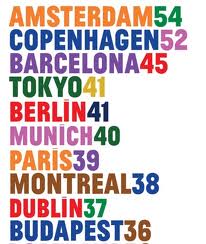
The Copenhagenize urban cycling index 2011


I  do not want to brag too much about it, so it will be a pretty quick post, i.e. no deep analysis, whatever that means. Others have done it already.


This year, Montreal made the top 10 and is actually the only North American city there. Which is totally normal. This place is definitely not receiving all the credit it deserves.

In the top 20, only Portland, San Francisco and New York join Montreal which is pretty fair, even though I am surprised a bit not to see Toronto somehow... It probably failed to make it based on the political atmosphere. Vancouver, the only other Canadian city with some potential did not make it either. Now that's totally understandable as Vancouver's bike culture is totally controlled by its sub-cultural groups. My assessment last time I went was that it had a very nice recreational network and culture but nothing utilitarian. Plus, the helmet law kills it all.

It is always unsettling to see cities the size of Portland ganged up with the New York's and the London's of this world. Why not include Davis, Lyon or Bordeaux then? Aren't smaller cities more cycle-friendly by default anyways? And what about the position (i.e. political, economic etc.) these cities hold within their region and with respect to other cities, in other words is Portland's status in the West coast (see I am being nice, I am not even comparing it to the entire US, just to the West coast) the same as say, Paris' position within France, Barcelona's position within Spain, or London's place within Britain? Why compare apples to oranges?
[Dodging and running for cover]
Ok, ok... Whatever.

Now, the big scoop (to me) is Barcelona, right after Copenhagen, ahead of Tokyo and Berlin. Who would have thought? I spent one year in Spain about 10 years ago and I do not remember seeing even *one* bicycle anywhere. Rather, I quite clearly remember being honked to get the fuck out of pedestrian crosswalks  a.s.a.p. so asshole motorists could rape red lights full blast under the police's absolute placid gaze. Ok, I was in Madrid (ahem... oops... Dodging!) and it was way back then, so I am well willing to accept that within 10 years, with no dominant sub-culture to control the cycling practice, you can achieve such great results in getting normal people to view cycling as a safe  and valid option. I just need to go check that out, it must be quite a sight.

I am *very* skeptical of Paris being more cycle-friendly than Montreal but hey, it's been a little while that I have not properly cruised this particular scene so I'd need to go back to get a better (i.e. updated) assessment. I'll see if my sister decides to haul her soon-to-be-born baby around, something she would definitely do in Montreal. Yep. These are the real-assed, non-bullshit tests. It's either pass or fail so we'll see.

"cities marks for their efforts - or lack thereof - towards reestablishing the bicycle as a feasible, accepted and practical form of transport. Cities were given between 0 and 4 points in 13 different categories, with a potential for 12 bonus points awarded for particularly impressive efforts or results. In short, a maximum of 64 points could be awarded."
The 13 categories of criteria are as follows:

- Advocacy
This is one area where a lot of North American/Anglo-Saxon places fail, thinking they are well represented by their cycling organisations while a lot of these are very often working actively against cycling's best interests. Other advocacy efforts, such as Critical Mass events, usually only antagonise non-cyclists instead of generating the inclusive type of sympathy that Cycle Chic has been able to do in way less time than the other have had. Others, such as the constant push for always more cycling sports events, only concern those already interested, with the majority of the population not giving a flying fuck, i.e. useless advocacy in terms of urban cycling.
Vélo Québec on the other hand is as mainstream and as non-confrontational as you can get, keeping a soft-assed balance between sports (its roots) and urban cycling, with heavy involvement into infrastructure issues, all the while being the "voice of reason and moderation". This is not to the taste of a lot of Montreal's advocates (including me) but results in Vélo Québec being taken seriously by the authorities and being systematically invited to committees, panels, consultations etc. Their opinion is always heard and taken into account which is *not* the case of the other groups. May hurt but those are the facts.
Superior advocacy is one that associates stakeholders coming from outside of the cycling family, such as pedestrians, urban planning etc.because it gets more traction and generates better and concrete results. We'll see how this new adventure works out.
- Bicycle Culture
North American bike cultures are heavily dominated by sub-cultural groups such a the sports-lycra pack, the green ecolo tribes or the "kwoool" messenger infatuation thing. Yet, Montreal is not. Or not anymore. There are more normal people on bikes than sub groups. One only needs to cruise our lanes and paths to see that.
Oh, and hipsters are part of the normal population, like it or not. They're a marketing designated niche consumer group. That does not make them a sub-cultural group. Let's not do them this favour, it would be too much of a stretch.
- Bicycle Facilities
"Are there readily accessible bike racks, ramps on stairs, space allocated on trains and buses and well-designed wayfinding, etc?"

- Bicycle Infrastructure
 
We have bike paths dating back from the 1980's. The de Maisonneuve bike path, i.e. Claire Morissette bike path, which crosses downtown, is the busiest in North America with one million trips a year and countless jams at rush hour. That's what *mainstream* means. Of course, more, much more actually, needs to be done, but this would require a change in administration, hopefully coming in 2013. Our network is highly fragmented, starting and stopping randomly, does not cover certain neighbourhoods and insufficient in the downtown area.

- Bike Share Program 

Well I will not comment this one. Pretty obvious.
I will just say this: montrealers are so proud of their Bixi program that sometimes you would think they created the concept. Totally *NOT* the case. Bixi is a Vélib copycat. And Vélib is a copycat of a Lyon program. Which itself is a copycat of an older La Rochelle program. And those got their idea from somewhere else. Etc.

- Gender Split - Perception of Safety

 These two go together.
Anyone biking in Montreal will tell you there are as many women cycling as men. I see 50% women or even more on the streets. I have an extremely hard time understanding how the stats get the 1/3 or 29% female share. This does not square with the reality one can easily observe.
Maybe it is just a time delay issue, i.e. I am observing the 2011 scene with my eyes, while studies coming out even this year actually date back to 2010, 2008 or even prior.
Women being the canaries in the cycling mine, wherever you see them cycling en masse means the place is and feels safe. Better, whenever you see mothers hauling babies, parents trailing kids etc. you know you've got a winning proposition. 
 
- Modal Share For Bicycles - Modal Share Increase Since 2006
 
Officially, we are in the 2% modal share, which is an absolutely mystery to me. I really feel we are in the 10-15%.
My take is that it depends on what we call "Montreal" for the purposes of statistics. As well, there must be some sort of serious time delay between what we observe in the streets as of today, and the realities at the time of the stats gathering. See the gender-split issue above.
 
- Politics - Social Acceptance
 
On that subject, we are in a bipolar situation where everyone and their mama thinks cycling is cool, nice and a good thing. We are all happy and proud to be citizens of such a bike friendly city. Cycling is normal. You're not weird for being a cyclist. People in business attires and high heels galore. Some companies even encourage their staff to cycle.
Yet, the minute someone wants to touch a particular street, affect a specific light, update certain rules, those same people get up in arms against the changes, bitching at the cycling integrists, invoking pedestrian security, motorist security (?), mass bankruptcy in the local businesses and other similar nonsense.
We have to see how this evolves as well.

- Urban Planning - Traffic Calming
 
Right now, we are at zero. No budget, no political courage, no this no that. 


Ok, well...
Finally this ended up being a bigger analysis than planned. Anyways, we have to see which direction things go. We are at a tipping point where if the good decisions are not made on time, we could actually regress on the cycling front.
The current administration is not one that can handle this. They are not really interested and there is never any money  in their coffers (anyone guess where that money went?).
Once the broom is swept in 2013, maybe then we will be able to give a dynamic impulse to cycling in this city.


Tuesday, August 16, 2011

Nice videos: Amsterdam loves bikes

Now, do not drown your keyboards in saliva...


One day... maybe... sigh... maybe we'll get there... some day...
Sniff.
Ok, I'm fucking depressed now...

Monday, August 15, 2011

On bikes and flowers

Walked by this cutie the other day...
Love the urban feel, simple but functional: mudguards, chaingard, bell, front wire basket... The über and absolutely typical Montreal clunker...


Decorated with awesome funky kitschy taste!


Here is someone who completely got the message.


Totally Cycle Chic!


Friday, August 12, 2011

Nice videos: High fashion cycling

Further indicating a possible "mainstreaming" of cycling, high profile designers have chosen to communicate on this theme.

Armani


3.1 Phillip Lim


Now, is any of this a sign that cycling is becoming mainstream?
Those who believe in this theory seem to forget that fashion does not follow the crowds, it precedes it, it is avant-garde, sometimes engaging into areas where, well, not everybody follows them...
Then, another obvious point is the fact that these folks do not really care about cycling per se. It is the newest trend for them right now but we simply do not know how long designers will be interested in cycling. Their new-found caprice may last one season before scuba-diving or bare-ass skiing or whatever takes over.

Therefore, it is nice, we should definitely highlight it and surf the wave: it contributes to the positive zeitgeist, but I would not count on it in lieu of straightforward advocacy for decent infrastructure and laws.

Monday, July 25, 2011

Snapshots

The other day, on my way to the library, I took a few pictures.

Along the Berri bike path. This lane dates back from the 1980's and boy does it show! It could definitely use some renovations.


Plenty of people, as the segregated lane gives them confidence that traffic can never get into them.


As casual as casual can get.


 Almost empty Bixi station, busy day...


Bicycle share, more popular than ever!


The library bike parking lot.


Ste Catherine, pedestrianised for the summer. No bicycles allowed as the little "walk you bike" green signs says.


Whatever, seriously!! We can perfectly share that space. Police never enforces this nonsense anyways. When the crowd gets too thick, i.e. Friday/Saturday nights, people will naturally step down and walk/parks their wheels. Nobody needs to tell them... you could not get through anyways!


 Yep! territories are clearly marked. The is Beaudry metro station, the Village's core.


No ambiguity possible.


Sunday, July 24, 2011

Pimping up your city

In the art of marketing a city to its own inhabitants as well as to foreigners as a cycle-friendly environment, several approaches are possible. Yet, most will fall in either of two categories: minor league vs. major league style.

- The minor league approach

This video is an example that perfectly illustrates the points I am attempting to make.
Vancouver will be hosting the 2012 Velo-city Global conference. This video is a preview that debuted at the closing ceremonies of the 2011 Velo-city in Seville. It was produced under tight time constraints in a end of winter, beginning of spring context which may explain some of its shortcomings.
Still, it has all the elements of a minor league cycling approach.


In a minor league approach, unimportant elements will be prominently emphasized. In the video above, Vancouver's Olympic status is waxed on despite a complete lack of relevance to urban cycling. 

Gear will be thrust in the viewer's throat, if not verbally, at least visually. Helmets will be pushed like drugs, and safety-oriented contraptions will be displayed in very not-so-subtle fashion: high visibility vests, fluorescent apparel, protective gear etc.
This point is extremely important as the psychological impacts of such tactics run very deep in the collective psyche. The subliminal message behind this is that cycling is dangerous. Then it promotes the idea that a person's safety and physical integrity are an individual matter. Do not expect society or your city to be organised to ensure your protection because it won't. Don that armour and be afraid, very afraid... Should a car hit you, it was your fault. Everybody knows helmets and protective gear stop cars from running you over by creating an electro-magnetic field that repels motor vehicles.

Cycling will be portrayed as a tough-guy, sports kind of activity. In this video, the presenting host, Skip Swain, Norco's VP Sales, looks and sounds like a biking John Wayne avatar. The tone is dynamic is assertive. You see scenes of cycling along busy highways. You have the mandatory stop at the bike shop, i.e. cycling as also being about the mechanics, get-yer-hands dirty kind of attitude. Commuting is the biggie. There will be talks of showers and locker rooms at work, because you know, cycling is about sweating buckets and you necessarily have to arrive at work drenched in sweat. 
Untold psychological messages are that quality of life in such places is something for go-getters that one sweats to obtain. Not something casual, easy going, that everyone deserves for just being.

There will be no diversity in the people sampled. Only a few women, of the hard-ass type and mostly white break-ya-neck twenty something males or white mature hardcore men. Racial diversity will be minimal with no children or elder folks to be seen anywhere. 
Demographics will be terribly homogeneous which is a problem in the case of this video as Vancouver is a highly racially diversified city. What happened to the Asian community? Don't they bike as well? If yes where are they? If no, doesn't it tell loads about the "normalizing" of cycling in Vancouver, i.e. it is only a sub-cultural activity for whites only and has not yet reached mainstream status?

Unfortunately, this approach will only seduce those susceptible to identify themselves to this limited portrayal of cycling.
Which terribly sucks as Vancouver is actually a much grander cycling city than portrayed. I am convinced that none of these "mistakes" were intentional. They derive from a very pervasive take on cycling that is typical of North America. But with this approach, they ensure cycling rates will never improve beyond the residual sub-cultural groups already interested in cycling.
What you want is mainstream appeal.

- The major league approach

This second video is Seville's Velo-city 2011 Global conference promotional video.
Feel the difference.


In a major league approach, a woman does the talking or someone with a soft voice in a relaxed tone. No need to rush or hurry, there is plenty of time. 
The focus will be on the city itself as a liveable and safe environment. Quality of life is a given. It is being promoted. It is something the authorities will stand for in your name. Attacks on the car culture are clear and to the point: "cars are a thing of the past", "cars are the main polluters", there is no noodling around this, no talk of composing or compromising with the car culture. We fight it in your name! Trains and tramways are rubbed in your face.
Cycling is not just an individual choice, it is being pushed as public policy for everybody's benefit. Cycling will be presented as an integral part of a urban transportation cocktail of which bicycles are the centerpiece.
In that kind of approach, there will be talk of how laws and structures have been modified to ensure protection of citizens, whatever their transportation choice. You see loads of normally dressed folks cycling at a leisurely pace on nicely organized lanes. Women in flowing dresses, women in heels. Casual hats. People carrying groceries. Wicker baskets. Children casually accompanying their parents. Minimal helmets including on children.

You might also see folks strolling bare-feet by the beach or along marinas on cruisers. Bikes parked in front of terrasses and cafés whose owners are sipping expressos and caipirinhas. Folks cruising parks. Lovers of all kinds holding hands or piggy backing because it is safe to do so. Folks giving each other lifts. Racial and age diversity will be obvious as every community and every demographic will feel safe in joining in.
There is talk of culture as well as sports as these are major components of urban and fulfilling quality of life.

So, where do we stand in Montreal?
Montreal cyclists overwhelmingly are voting of a major league approach as they take over the city on their clunkers. However, our authorities and administration are still stuck in minor league scared as they are of God knows what...

A similar discussion already took place at the Urban Country which you can read here along with James' amazing analysis.

Saturday, July 23, 2011

Le gamin au vélo

I have not seen that movie. I do not know whether it is good or not. Here is a link to a critique in the Guardian.
It won the 2011 Grand Prix du Festival de Cannes.


I just like the images. I wonder about the impact such images can have in the long term. What will happen as more and more bicycles are featured in mainstream media?
And would it be enough? Are PR, marketing and image communication enough? Should we give up on traditionnal advocacy?

Here is the official trailer


The kid's bicycle is pretty well featured throughout the film as something normal that normal people do.


Of course, it's a French movie and the story happens in France where the approach is more of the Major League type.


We can only only wish that this trend continues. For sure it will at least have some sort of positive subliminal impact.

Friday, July 22, 2011

A week-end adventure: Boston

July 1st was Canada Day, so dear hubby and I decided to take a full five day week-end to explore Boston.

We toyed for a while with the idea of bringing our bicycles along but, fortunately, we decided against it. Because it would have been the hassle of hassles. As car-free people, we would have had to either rent a car, and then struggled the entire week-end to find parking for both car and bikes, or haul them with us in the bus which looked like a pain, as per what we observed from the two people who did it in our group. Another option would have been to rent some there.
But we quickly realised that Boston was not a city in which we could cycle. This, by the way, is no judgement with respect to those who can, it's only a factual statement.

Boston is a highly acclaimed place in Montreal and rightly so.
First because it is pretty close and easy for us to come and go. Second because it has the reputation to be "similar in body and spirit". Unfortunately I have to disagree with that one.
- Boston is definitely a New England Beauty with this very old Brit touch. Montreal's older areas are totally Vieille France,
- Boston has a je ne sais quoi that is very bourgeois, typical of wealthy successful cities such as Bordeaux, in an old money type of way.  Montreal is heavy on blue collar heritage, with a bohème flair.
- Montreal is very multicultural, Boston seemed very WASPy.
- Montreal is a city with lots of cookies, weirdos, bozos, zozos, kekes, name it, we have 'em. Boston on the other hand looked dignified, pulled together, with an elite club type of vibe. If I did not know better, I could have believe that this place was conservative...
- Montreal is decently cyclable and totally walkable. Boston was... not.

Now, of course I am totally biased, and I perfectly realise than in five days, you do not get to see enough to pass judgements. But boy, were those pedestrian push buttons pissy!!
No wonder people j-walk left and right with a fury: how can such a civilised city organise its traffic so that it is up to pedestrians to do the push-button legwork, wait to no end that the lights finally turn green for a miserable few seconds, all of that to have people squirrel on the crosswalk like mice as cars roared in impatience at those annoying pedestrians wasting their time. Car traffic is absolutely demented, folks speeding like their lives were at stake.

I guess the problem is mine. I take full responsibility for it. I allowed myself to get sucked into the whole Boston/Montreal sisterhood thing which is a myth. And then I did not research it enough, basing my decisions on the perception I had of the city from the abusive consumption of nice blogs such as Lovely bicycle, a wonderful one that I consult everyday. Had I been more attentive and more discriminating, I would have realised that Montreal's cycling reality, i.e. active and vibrant cycling downtown vs. dead suburbs does not necessarily transpose to other cities. Made that mistake in Chicago years ago as well and boy! was that week-end boring. Well, that template could not be applied to Boston either. 

We stayed in the South end, a lovely hip neighbourhood with a subtle and toned down gay twist... Could never figure out whether this was the official gay village (I did not investigate, mind you). Montreal's gay village is promoted as such and things could not be clearer once you've stepped into the territory. Major social mix as well which is always nice unless you like golden ghettos.

We walked the entire "downtown": Back Bay, Commons, Chinatown, Seaport, Beacon hill, West end, North end/Little Italy, Charlestown, and we metroed to Cambridge. Utilitarian cycle paths were practically non-existent, with whatever existed narrower that the skinniest fixie handlebar and squeezing you against the curb! Some nice recreational ones along the Charles river.
Cambridge, Harvard area, was another surprise. Campus was as stately and impressive as I expected, but again students did not seem to be avid cyclists. I know, it is summer recess... Cliché comparisons between McGill and Harvard did not hold water either: Harvard seemed way too formal and serious a place, while McGill is all about Frosh, pyjama parties, and rez showdowns these days (bias!). Ok, I can never take this Alma Mater of mine too seriously, despite all these years. Cycle traffic around McGill campus forced the school to ban bikes on-site and the city to create all kinds of (crowded) lanes around campus and in the Ghetto, including one fully segregated to connect with the Claire Morissette lane. Did not see any of that around Harvard, despite the school's Ivy League status and alleged influence over the State and the city.
Big surprise and slight disappointment.

Other that that, nice hot week-end. Lots of deliciously maintained refreshing parks (now, there Montreal could take a lesson or two). We walked our feet out. Dear hubby categorically refused to try the rickshaws, fearing for his life.
We saw maybe a hundred-ish cyclists in total. Over five days.
Local Bixi, the Hubway, was launching that very week-end and received a warm welcome of some sort. Will to have follow up on it.
Finally, on the very last day, we stumble upon Urban Adventours which nicely provided us with the much sought after "best of Boston by Bicycle" map, which confirmed what we intuitively figured: whatever bike paths there were we actually touring trails. nothing utilitarian.

We came across a cookied fellow who owns a bike shop downtown, makes customs bikes, and spent his entire time insulting European bicycles, especially Dutch ones (Gazelle, not to name any brand), calling them toys and detailing how shitty they were. Of course, we all know that the Dutch et al. do not know the first thing about bicycles, right, with their lousy and pathetic bike culture. On the opposite, Boston has great lessons to give to Europe, right, with its vibrant bicycle industry and its extensive market base. Ahem...


On Beacon Hill, we took a picture of a sample love letter the city left to several of its cycling citizens:


Now, all bikes on the street had this sweet notice attached to them. All were nicely tucked and secured, no anarchy or dumpster-like parking like we have. All were very fine bicycles, "fine" as in clean and nicely maintained, nothing like Montreal's dreadful clunkers that the police either auctions out (when salvageable) or sends to eco-social recycling (when complete junk). No alternative parking accommodation was to be seen anywhere. It is reasonable to assume that the apartments on that streets were either too small or too cluttered to welcome these bikes. What is a cyclist to do really?
What is this about, honestly? What is the point? How is it that city officials have so much time in their hands?

All in all, nice and highly educational weekend. Wonderful time. Next time we shall try Cape Cod.

Thursday, July 21, 2011

What exactly does "Montreal" mean?

      
We all throw these names around, New York, Portland, Toronto, San Francisco, Vancouver etc. with the assumption that the receiving party knows what we are referring to. But do they?
Does New York actually mean the same thing for a New Yorker, for an American tourist, for a European tourist, for the tax payer, for the consumer etc.? For years, New York meant Manhattan to me. What a complete shock to find out that "New York" is actually a conglomerate of five different boroughs, four of which had been totally off my radar.

Similarly, what exactly is Montreal?
- It is the downtown area?
 - Is it the area comprised within the reach of a metro station?


- Is it the area comprised within the reach of a suburban train station?
- Is it the whole Island?
- Are Westmount, Hampstead, Côte St Luc, TMR and all the independant municipalities part of "Montreal"?
    

 - Is it the whole metropolitan area, i.e. are the suburbs part of Montreal? How far can you live and still be living in "Montreal"?
     

Well the answer depends on what you connections are to this maze of identities, and how strongly you feel about them. It also depends, more prosaically, on where you live.
But more importantly, your answer to that question will be more informative about your daily cycling experience, your enjoyment of the infrastructure, the availability thereof and your perception of what the city's bike culture is all about, than anything else you may have to say about Montreal.

Now, this is my personal take on it. You are totally entitled to yours.
Please note that I live downtown, which crucially and deeply affects my perception of reality and conditions my lifestyle. Please further note that this was a choice, we all choose where we live, and this choice turned out to be a lot less expensive than that of those who chose exile.

1. Any area off the island is not Montreal.
Montreal being an island, you either live on it or you don't. And where you have an island you have bridges. Those are hell to cross. We are talking one hour, up to two or three after snowstorms.

2. Anything outside of the island is a suburb, the 450 area (code).
If you live there, whatever bicycle activity you engage into can simply never be included in Montreal's cycling culture. Lots of sporting, week-end, fair-weather and recreational cycling. But nothing urban. Nothing utilitarian. Nada.
Ok, a few die-hard hard-asses practice long-haul commuting, crossing bridges everyday, arriving at work drenched in sweat etc. That's not what we are talking about here either.

We're talking hoping on your clunker and zipping left and right to the movies, to the theater, to the Jazz Fest, to have a drink with your pals, to go get some ice cream, to go to the pool, the grocery store, to the bachelor party, to the library, to the park, to the gym, to the guitar lesson, to pick up your kid etc. in addition to, of course, going to work. You've got your laptop  and gym stuff in a pannier or in that messenger bag, salad, bread and lemonade in that wicker basket and your cell phone within reach because, man! Those buddies of yours changed the plans again: apparently the lounge/restaurant sucks ass so you guys are going straight pool sharking at Ratty's. 
If that's not what you are doing, you're not in business. Period.

3. Anything outside the reach of a metro station is a suburb as well. Depending on the bus network around your area, you might still live in a urban context, but most often than not, it not the case. See point 2.
Typically, West island and East end are not "Montreal".
However, independent municipalities such as Westmount, TMR, Hampstead, Côte St Luc and Montreal ouest are "Montreal" (unfortunately, more on that some other time).

 4. Within "Montreal", not all neighbourhoods weight the same in terms of influence on the city's bike culture.
Some are insignificant and merely followers. Others are leaders in that respect. The Plateau Mont Royal is such a neighbourhood. Actually, it is the main trend-setter, like it or not.
Now, everybody loves to hate that neighbourhood, especially the 450s who cannot spit enough venom about it, yet would sell their souls and their mamma's to live like that. Plateau Mont Royal is Montreal's Williamsburg... enough said.
However, people in there worked hard to get that place to be way it is now. Bicycle lanes did not fall from the sky, nor did they bloomed after last rainfall.
People in there vote for the appropriate people, who in return defend their interests like they are supposed to. And they do it for real. And they have the political balls to hold on tight to these decisions. Chapeau!
Instead of being jealous and bitter, we should do just the same, instead of voting corruption in. Bitching and whining while sitting on one's ass and doing nothing never got anyone anywhere. Again, enough said.

Bottom line, whenever you interact with someone from Montreal, know that unless you know exactly where that person lives and their roaming range, you cannot usefully interpret their take on the city's bike culture. Unless they live or frequent areas where it is really "happening", their take will actually be worthless.

What is the point of all of this rambling?
To help interpret cycling and commuting rates. Throwing cities modal share rates around mean nothing unless we can break it down into neighbourhoods.
In this document I found on the Internet, nine cities are analysed in great details: New York, Portland, San Francisco, Chicago, Toronto, Vancouver, Montreal, Minneapolis and Washington. Very interesting read.

More interesting even are the neighbourhood breakdown maps, on pages 460-462. We get to see exactly where in Portland, Washington and New York people actually cycle. We can see that only certain central areas really matter, the remainders being more or less cycling deserts:

- I am actually not very impressed by New York's detailed rates. With all the hype being waxed on about Williamsburg, one would have expected rates in the 5 %. Alas, New York it is barely pushing the 2 % even in its hottest areas.
- Portland on the other hand has a VERY interesting configuration. On page 461, we can see 6-8% in central boroughs, then a sharp drop outside of that area.

Montreal's Plateau Mont Royal, the most populated neighbourhood, blasted the 10 % this year, as Velo Quebec's President announced in June, while Rosemont, Outremont and Downtown are pushing the 5 %. All of it with a non-supportive administration contrary to Portland.
The latest report on cycling in Quebec is available here in English.
It is therefore not normal that Montreal suffers such under-representation in the blogosphere and on the international cycling scene.

Tuesday, July 19, 2011

Le pourquoi du comment: some background

Ever since I began exploring the internet for cycling information, the virtual cycling community has never ceased to amaze me for its dynamism and resourcefulness. Places like Portland, San Francisco and others were being celebrated to no end as cycling heavens.
However, sometimes, some things would just so ring wrong in my ears: as a regular Montreal cyclist, details from these descriptions would simply not balance out... little tidbits of no individual importance but which collectively created a cognitive dissonance in the back of my head.
Somehow, the more I explored the blogosphere, the greater that cognitive dissonance became, as I read countless bloggers wax on lyrics about achievements that sounded so trivial... to me.
“Woohoo!! They've painted the second bike lane of the city on street so and so and it runs over 100 m!”
Commentators would join in the rejoice and the city would be celebrated as one of the greatest cycling cities in North America.
While happy for them, I could not help but think about the segregated bike lanes, each running a few blocks from my home, dating back from the 1980's, that every Montrealer and their dog takes for granted.

Finally, in 2008, equipped with my Norco Lady Vermont under one arm and dear hubby under the other, I arrived in New York to attend the Five Boro Tour. We endeavoured to cruise around town in search of the oh-so-celebrated wonderful cycling culture. Oh boy! Death breathed down our neck the entire week-end, especially on Staten Island... But I finally understood why every single progress was such a big deal: they were starting from far behind and swimming upstream a megalomaniac car-obsessed culture. No wonder even the smallest victories were so huge. My thoughts did not go any further however, and the dissonance, while tamed and muted, kind of remained and would pop up every time articles celebrating such and such city's vibrant cycling culture.

Fast forward a few years to this past June. Mikael Coleville-Andersen comes to Montreal to present his “Four goals for promoting urban cycling” conference. His passage is well covered by the Montreal media who just love when Europeans come all the way here to tell us how much we are like them.
And indeed, it seems that Montreal has got that little something that could (finally) propel it into the league of the grown ups (i.e. Amsterdam & Copenhagen) as the leading North American cycling city... if only... if only someone had the political balls... but more on that some other day.
Montreal is not receiving all the credit that it deserves. At last, someone finally articulated what has been in the back of my mind for all those years. This post has been a real eye opener for me as all of what he is describing is completely taken for granted by Montrealers, while being totally ignored by the international cycling community.
Yet, Mikael is so taken with our dear Villa-Maria that he comes back home all confused, still thinking about it... and announces that he shall be back: no problem, your groupies will await your return!!

This is how I came to the realisation that I should create a blog where I would intend, at my very humble scale of course, to contribute to reveal this wonderful and vibrant cycling to the world.