The city of Montreal will be holding public consultations throughout the boroughs to discuss fair and proper sharing of the the cycle network.
We all know that cycle paths are not only used by cyclists, the users for which they were conceived, but by joggers, dog walkers, stroller pushing parents, wheelchairs, mopeds, e-scooters, roller-bladers, skateboards and plain old obnoxious pedestrians.
The issue of who should or not not have access to the network will be à l'ordre du jour. If you are in Montreal, please book the relevant dates in your agenda.
I truly hope that we can get those *freaking* electric mopeds ruled out once for all.
Now before anyone sends me loads of bitchy e-mails, THIS is what I am talking about:
Those need to go: they are bulky, heavy and dangerous. They will fight back, expect a big turn out at the city Hall as they got screwed by the sellers who promised them they could go on cycle paths forever. Tough luck, everywhere in the world they are being expelled from them.
Normal e-bikes are fine. Like these.
Basically, the cut-off is you should be able to pedal it like a normal bike. If you cannot handle a Tour de l'Ile on your "bike", get out of the path.
Now, pedestrians. Well, there are pedestrians and pedestrians:
- You have those, obnoxious, PITA pedestrians who pay no attention, don't give a fuck about your bell ringing, step right in front of you and insult you. These need to be steeply fined.
These are general assholes anyways and cause problems to all. They are the same who jaywalk left and right, cause accidents everywhere, smoke in your nose where it is prohibited, yell in their cell phones in libraries, cut you off and overtake you on the right on the highway etc.
By that, I mean there is no "pedestrian issue" with these, there is a general common sense and manners issue.
- The other pedestrians can be lumped with the joggers etc.
With these, we usually have an infrastructure issue. They will be on the path because there is no sidewalk, or the sidewalk is too narrow, full of holes, of obstacles, too busy (i.e. not big enough), poorly designed, was located in an area that should be exclusively pedestrianised or was stolen from them!
Below, example of a well designed path where it is clear, by design, that only cyclists are allowed, with proper sidewalk next to it..
Poorly designed "path" where said path looks like some plain old sidewalk.
Of course, pedestrians do not realise they are on a bike path! In addition, Place des Arts (the location in this picture) is a central location in Montreal where virtually *ALL* the festivals are held. Why cut a bike path across this area? You know there will be permanent conflicts with peds. As a matter of fact, the path was closed virtually all summer with cyclist dismount signs everywhere. And this was true for most of the Maisonneuve path: around Berri (picture below), Crescent, McGill College etc. Fucking useless!
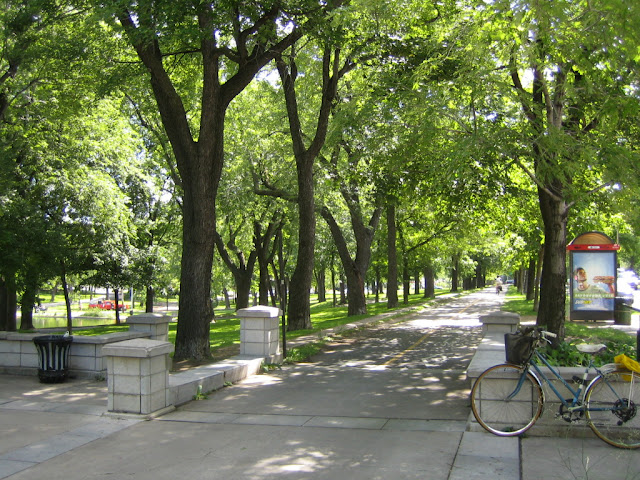
Another example: sidewalk/footpath too narrow AND stolen from pedestrians. In the Parc Lafontaine, one of the nicest bike path sections of Montreal, both bike path and footpath are extremely busy.
The bike path is pretty decent,
 |
| Wikimedia Commons image |
But the footpath is tiny. Normal a good chunk of it was allocated to the bike path!
 |
| Wikimedia Commons image |
This area is source of major conflicts with joggers and dog walkers, who, understandably also want to enjoy the park!
Last example is the Old Port which is a so-called"mixed" area. Perfect example of too busy an area for telling cyclists they can use it.
So, unless these infrastructure deficiencies are addressed, problems will persist.
Now, for the other users:
- Roller blades and skateboards *BELONG* in the bike path, end of discussion.
- Strollers get in bike paths when the sidewalks suck. Fix'em and parents will go back on it.
- Wheelchairs: well, I don't know what to say. I know my opinion will sound very cruel and insensitive to many.
By law they belong on the sidewalk. The chair is a substitute for legs and does not have a vehicle status. Therefore, they are pedestrians who, by law in Montreal, belong on the sidewalk.
I do not have any personal problem in sharing the path with them. But it would be much better if they lobbied to obtain better sidewalks. Same with parents with strollers.
They might want to remember that all sidewalks corners have be lowered for their convenience. If they abandon them now, no one will be there to push for their improvement. In the same fashion that cyclists cannot ride the sidewalk, I truly believe wheelchairs should not use cycle paths.
Yet isn't it filthy hypocritical coming from someone who claims rights to BOTH path and road and occasionally rides the sidewalk? Well, yes. That's why, whatever the final decision, I am ok with wheelchairs.
I am sure a big crowd will show up, it will be a blast!
Full communiqué below, in French.
*****
Montréal, le 12 septembre 2011 - La Commission permanente sur le transport et les travaux publics invite la population à participer à l'assemblée publique itinérante qui portera sur la question du partage du réseau cyclable montréalais, et ce afin de donner suite à une demande citoyenne.
Conçu à l'origine pour répondre aux besoins des cyclistes, le réseau cyclable montréalais fait actuellement l'objet d'un partage. On constate que ce réseau est également utilisé par des personnes qui se déplacent à pied, tant au pas de marche qu'au pas de course, en patins à roues alignées, en planche à roulettes, en aide à la mobilité motorisée ainsi qu'en scooter et en vélo électriques.
Par conséquent, la commission devra se pencher sur la problématique de la compatibilité entre ces différents types de déplacements sur les voies du réseau cyclable montréalais. Ainsi, dans le cadre de cette assemblée, il est prévu de réserver la première séance publique à la présentation de l'information technique caractérisant la configuration du réseau cyclable montréalais et les différents groupes d'utilisateurs se côtoyant sur ses pistes. Les représentants de la Division des transports actifs et collectifs, de la Direction des transports de la Ville de Montréal, se chargeront de cette présentation. À cette occasion, le public aura la possibilité de poser des questions aux experts. Par la suite, les personnes qui le souhaitent seront invitées à prendre la parole lors de l'une ou l'autre des trois séances réservées à l'audition des commentaires et au dépôt des mémoires. Quant à la dernière séance inscrite au calendrier 2011, elle vise l'adoption des recommandations de la commission, le cas échéant.
L'assemblée de consultation publique se tiendra comme suit :
HEURE: 19 H 00
DATES ET LIEUX:
- Le 22 septembre 2011 − Présentation du dossier (Centre-ville)
Hôtel de ville, salle du conseil, 275 rue Notre-Dame Est / Métro Champ-de-Mars
- Le 26 octobre − Audition des commentaires et dépôt des mémoires (Nord-Ouest de l'île), Centre communautaire de l'Est, 9665 boul. Gouin Ouest / lignes 68, 268, 213 et gare Sunnybrooke
- Le 27 octobre − Audition des commentaires et dépôt des mémoires (Centre-Est de l'île), Arrondissement de Ville-Marie, salle du conseil, 800 Boul. de Maisonneuve Est / Métro Berri-Uqam
- Le 23 novembre − Audition des commentaires et dépôt des mémoires (Sud-Ouest de l'île), Arrondissement de Verdun, salle du conseil, 4555 rue De Verdun / Métro Verdun
- Le 1er décembre − Adoption des recommandations (Centre-ville)
Hôtel de ville, salle du conseil, 275 rue Notre-Dame Est / Métro Champ-de-Mars
Documentation
Le document de soutien à l'assemblée publique peut être consulté dans les bureaux Accès Montréal et les bureaux d'arrondissement, les hôtels de ville des villes de banlieue, de même qu'à la Direction du greffe, salle R-134 à l'hôtel de ville de Montréal. Le document est également accessible sur le site Internet des commissions :
www.ville.montreal.qc.ca/commissions
Inscription Les personnes qui souhaitent participer à la période de questions et de commentaires du public sont priées de s'y inscrire, à l'avance, en communiquant avec la Direction du greffe au 514 872-3770 ou par courriel à l'adresse suivante :
commissions@ville.montreal.qc.ca. Il est également possible de prendre la parole en s'inscrivant sur place, et ce 30 minutes avant le début de la séance.
Les commissions permanentes sont des instances de consultation publique instituées par le conseil municipal et le conseil d'agglomération. Conformément à la Loi sur les cités et villes et à la Charte de la Ville de Montréal, leur mission consiste à éclairer la prise de décision des élus municipaux et à favoriser la participation des citoyennes et citoyens aux débats d'intérêt public.
La Commission sur le transport et les travaux publics est présidée par M. Luis Miranda, conseiller de ville et maire de l'arrondissement d'Anjou. Quant à Mme Elsie Lefebvre, conseillère de ville à l'arrondissement d'Ahuntsic-Cartierville, elle agit en tant que vice-présidente. Les membres de la commission sont : M. Maurice Cohen, conseiller de ville à l'arrondissement de Saint-Laurent; Mme Véronique Fournier, conseillère de ville à l'arrondissement du Sud-Ouest; Mme Ann Guy, conseillère d'arrondissement à l'arrondissement de Verdun; M. Beny Masella, maire de la Ville de Montréal-Ouest; M. Alex Norris, conseiller de ville à l'arrondissement du Plateau-Mont-Royal; M. Lionel Perez, conseiller à l'arrondissement de Côte-des-Neiges−Notre-Dame-de-Grâce; M. François Robert, conseiller d'arrondissement à l'arrondissement de L'Île-Bizard−Sainte-Geneviève; M. Edgard Rouleau, maire de la Cité de Dorval et M. Bertrand Ward, conseiller de ville à l'arrondissement de Pierrefonds-Roxboro.


